
Download this Game FREE and File it Away for Later!
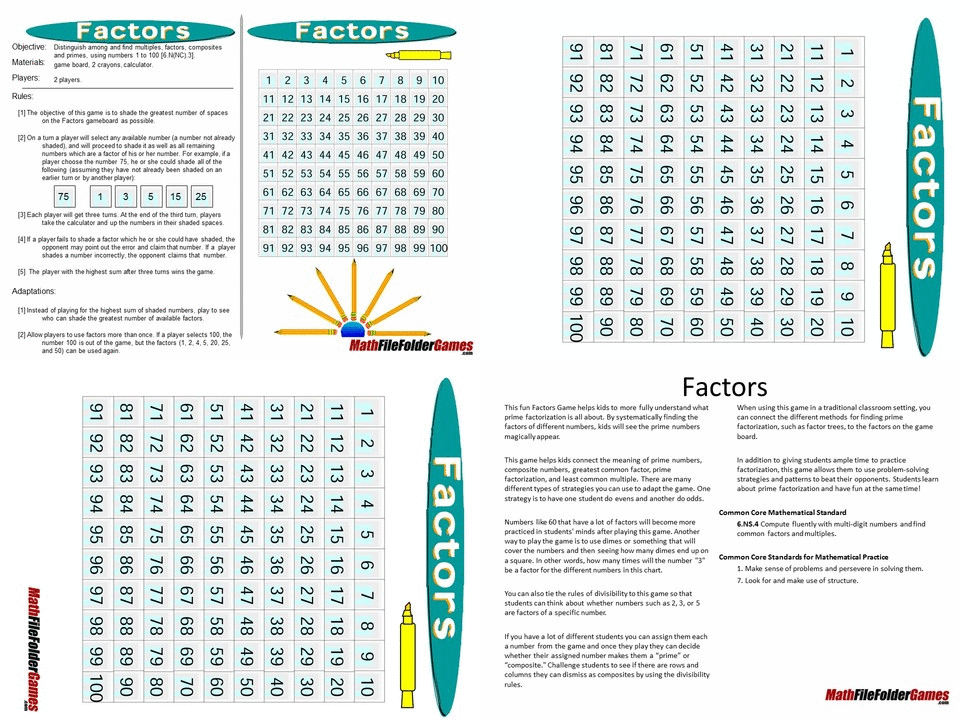
This fun Factors Game helps kids to more fully understand what prime factorization is all about. By systematically finding the factors of different numbers, kids will see the prime numbers magically appear. This game helps kids connect the meaning of prime numbers, composite numbers, greatest common factor, prime factorization, and least common multiple. There are many different types of strategies you can use to adapt the game. One strategy is to have one student do evens and another do odds.
Numbers like 60 that have a lot of factors will become more practiced in students’ minds after playing this game. Another way to play the game is to use dimes or something that will cover the numbers and then seeing how many dimes end up on a square. In other words, how many times will the number “3” be a factor for the different numbers in this chart. You can also tie the rules of divisibility to this game so that students can think about whether numbers such as 2, 3, or 5 are factors of a specific number.
If you have a lot of different students you can assign them each a number from the game and once they play they can decide whether their assigned number makes them a “prime” or “composite.” Challenge students to see if there are rows and columns they can dismiss as composites by using the divisibility rules.
When using this game in a traditional classroom setting, you can connect the different methods for finding prime factorization, such as factor trees, to the factors on the game board.
In addition to giving students ample time to practice factorization, this game allows them to use problem-solving strategies and patterns to beat their opponents. Students learn about prime factorization and have fun at the same time!
Download this Game FREE and File it Away for Later!
The Factors Game Meets Common Core Mathematical Standard
6.NS.4 – Compute fluently with multi-digit numbers and find common factors and multiples.
Common Core Standards for Mathematical Practice
1. Make sense of problems and persevere in solving them.
7. Look for and make use of structure.
Download this Game FREE and File it Away for Later!
Factors: Multiples, Factors, Composites, and Primes
Why Teachers Love It
If your students love a good competition and a bit of strategy, Factors will quickly become a class favorite. This hands-on game turns the abstract ideas of factors, multiples, composites, and primes into something visual, tactile, and—most importantly—fun. As students color in numbers on the grid, they start to see patterns emerge: why some numbers have so many factors while others have only two. Suddenly, primes aren’t just a list to memorize—they’re the numbers that stubbornly refuse to share their space!
This game fits perfectly into math centers, early-finisher time, or a quick review warm-up before diving into divisibility rules or fraction simplification. It also invites rich math talk: players justify which numbers are factors, debate over missed ones, and spot new relationships between multiplication and division. Parents and tutors can easily join in at home using only a pencil, crayons, and a 1–100 chart. And because it’s hands-on, it draws attention away from screens and back toward genuine number sense conversations—a much-needed antidote to the passive click-and-guess world of digital practice.
Teacher Discussion Prompts
Use these to spark conversation and strengthen reasoning:
-
“How do you know that’s a factor of 75?”
→ Listen for division reasoning (“Because 75 ÷ 5 = 15 with no remainder”). -
“Which numbers have the fewest factors? The most?”
→ Students will discover primes vs. composites naturally. -
“What patterns do you notice as the numbers get larger?”
→ Expect comments about even numbers and multiples of 10. -
“Why might this game help you with simplifying fractions later?”
→ Encourage connecting factors to greatest common factors and equivalent fractions.
Factors transforms rote memorization into playful discovery. You’ll love watching the “aha!” moments when students realize why some numbers are “factor-rich” and others stand alone. Whether used as a 10-minute warm-up or a full-blown math center, this game fosters communication, collaboration, and curiosity—the heart of good math teaching.
BEST SELLING MIDDLE SCHOOL MATH GAMES
 Get the above math game PLUS 41 more fun middle school (& upper elementary) math games to use with your students.